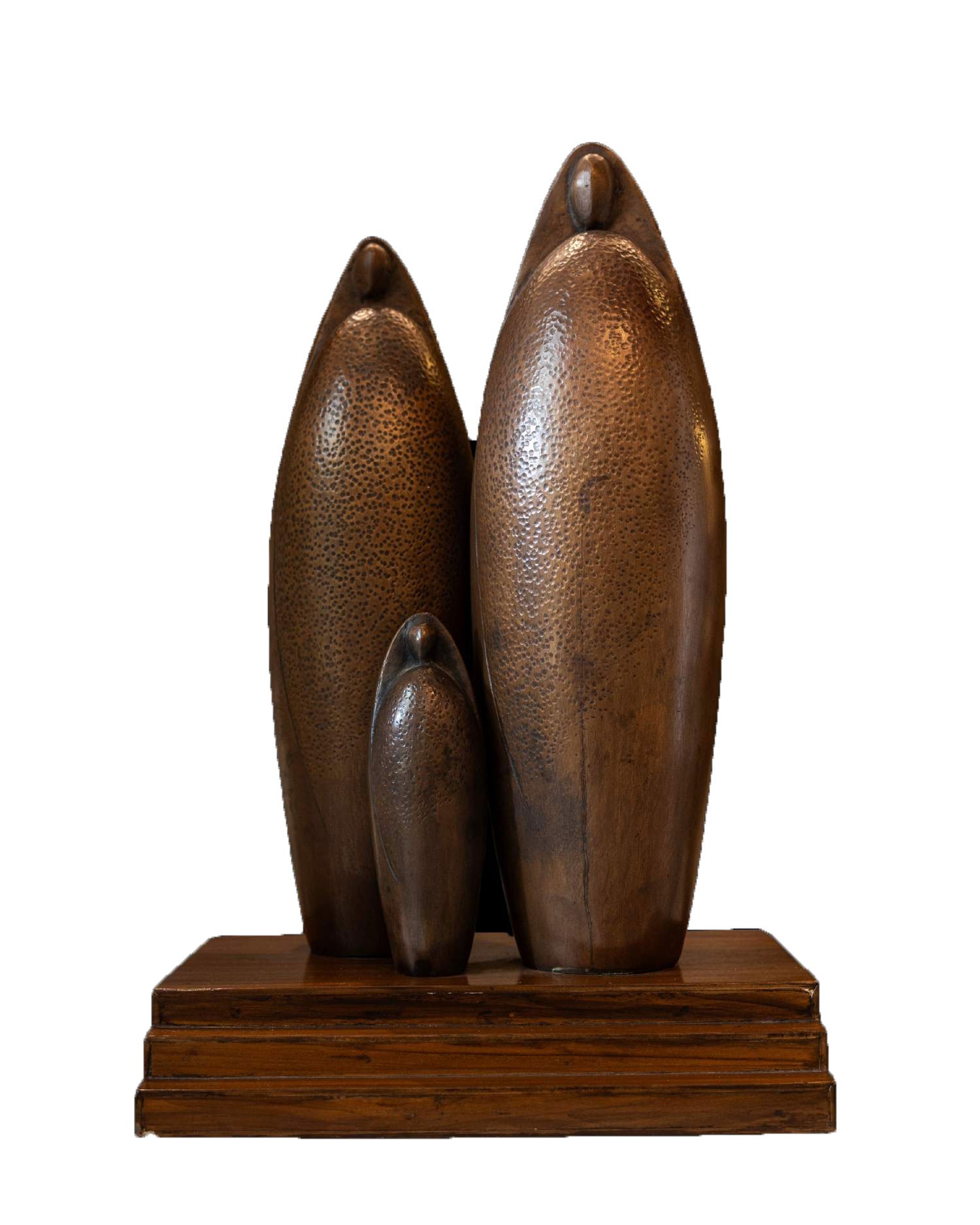
Pradosh Dasgupta
Prodosh Dasgupta (10 January 1912 – 29 July 1991) was a pioneering Indian sculptor and a central figure in the evolution of modern Indian art, whose work helped redefine three-dimensional form in the mid-20th century. Born in Barakar, Dhaka (now in Bangladesh), he began his artistic education in India before studying sculpture at the Lucknow School of Arts and Crafts and later advancing his training at the Royal Academy of Arts and the LCC Central School in London and the Académie de la Grande Chaumière in Paris, where he also studied bronze casting.
Returning to India in 1940, Dasgupta established his studio in Calcutta and became a founding member and long-serving secretary of the Calcutta Group (1943)—one of the earliest collectives of modern Indian artists committed to a global aesthetic beyond academic conventions. His sculptures blended influences from Indian classical traditions with Western modernism, creating a distinctive visual language that ranged from figurative to semi-abstract works marked by fluid rhythm and expressive form.
In addition to his artistic practice, Dasgupta made substantial contributions as an educator, curator, and critic. He taught at institutions including M. S. University, Baroda, and Government College of Arts and Crafts, Calcutta, before serving as Director and Curator of the National Gallery of Modern Art (NGMA), New Delhi (1957–1970), where he helped shape one of India’s most important public art collections. He was also elected a Fellow of the Royal Society of Arts, London, and represented Indian sculpture internationally.
Dasgupta’s works such as In Bondage (1943), Jai Hind (1948), Genesis (1971), Sunflower (1978), and Philosopher (1984) reflect a lifelong search for rhythm, energy, and form, bridging realism and abstraction in bronze and other media. His art continues to be celebrated in retrospectives and exhibitions, and a major NGMA retrospective in 2008 reaffirmed his enduring impact on Indian modernism.
Through his innovative synthesis of diverse traditions and his leadership in institutional and artistic circles, Prodosh Dasgupta remains a seminal figure whose work expanded the expressive possibilities of sculpture in India and beyond.