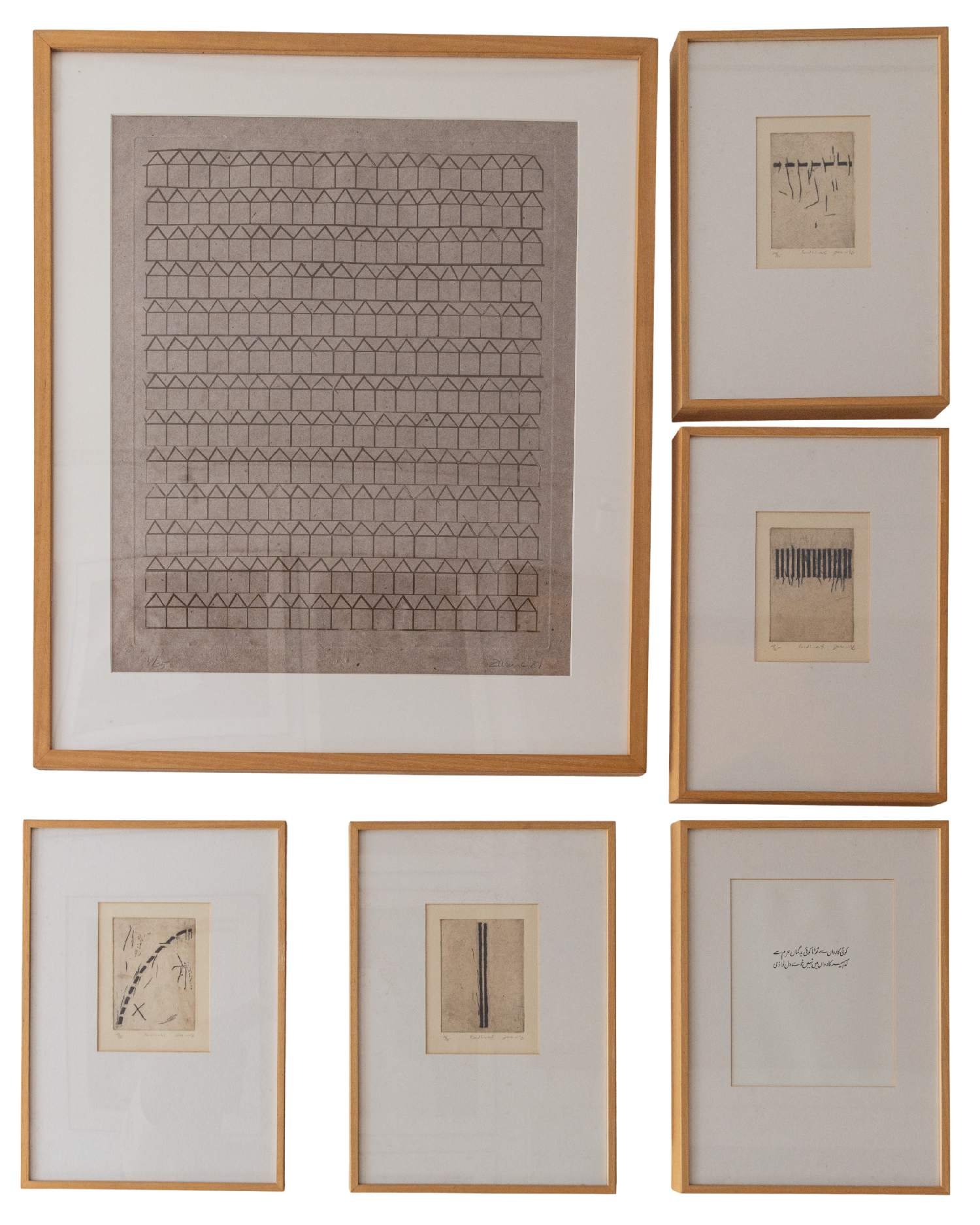
Zarina Hashmi
Zarina Hashmi (16 July 1937 – 25 April 2020), known professionally as Zarina, was a celebrated Indian-American artist whose minimalist yet deeply evocative practice reshaped contemporary printmaking, drawing, sculpture, and papermaking. Born in Aligarh, India, she began her academic life with a degree in mathematics at Aligarh Muslim University, a foundation that would later inform her precise use of geometry, line, and spatial structure in her art. Her early experiences of displacement during the Partition of India profoundly shaped her lifelong exploration of home, memory, borders, and exile.
Zarina trained in printmaking across continents—studying woodblock printing in Bangkok and Tokyo and intaglio with Stanley William Hayter at Atelier 17 in Paris—before settling in New York City, where she lived and worked for over four decades. Her work is recognized for its spare yet powerful visual language, often using simple lines, grids, and geometric forms to suggest cartographic journeys, lost homes, and the emotional landscapes of belonging and absence.
Her art was widely exhibited internationally. Notably, she represented India at the 2011 Venice Biennale, and her landmark retrospective Zarina: Paper Like Skin was presented at the Hammer Museum in Los Angeles before traveling to the Solomon R. Guggenheim Museum in New York and the Art Institute of Chicago. Solo exhibitions such as Zarina: Dark Roads, Life Lines, and A Life in Nine Lines showcased her evolving engagement with memory and displacement.
Zarina’s works are part of major museum collections worldwide, including the Tate Modern (London), Museum of Modern Art (New York), Whitney Museum of American Art, Solomon R. Guggenheim Museum, National Gallery of Art (Washington, DC), San Francisco Museum of Modern Art, and The Menil Collection (Houston), reflecting her enduring global influence.
Throughout her career she also engaged with feminist and art communities, teaching, curating, and contributing to dialogues about identity and diaspora. Zarina’s poignant, lyrical work continues to resonate for its clarity, quiet strength, and profound emotional depth—making her a seminal figure in global contemporary art.