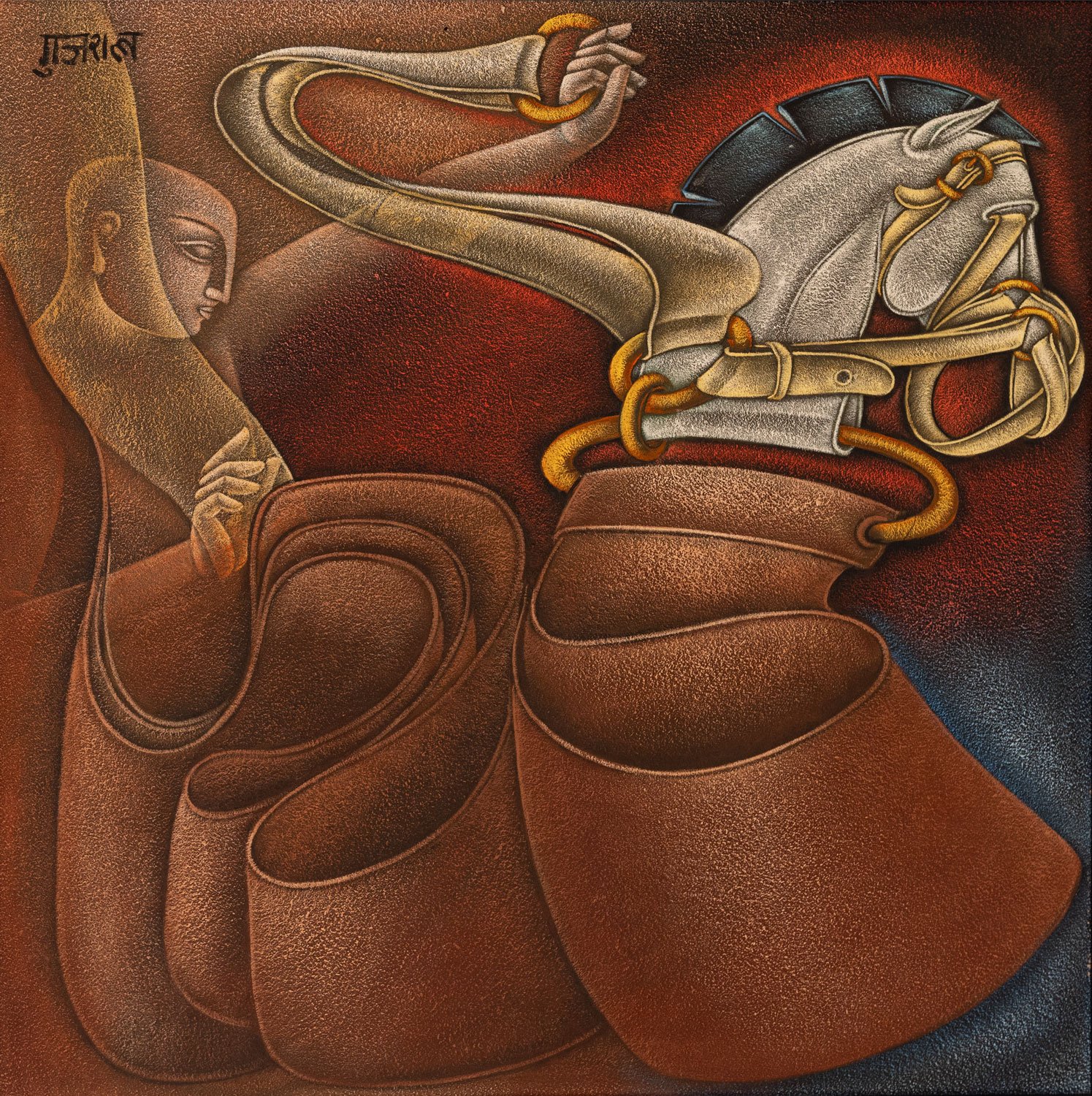
Satish Gujral
Satish Gujral (25 December 1925 – 26 March 2020) was one of India’s most versatile and celebrated modern artists, whose remarkable career spanned painting, sculpture, muralism, architecture, and writing. Born in Jhelum (now in Pakistan), Gujral overcame early challenges including a hearing disability to pursue art, training at the Mayo School of Art, Lahore, and later at the Sir J.J. School of Art, Mumbai. His work was profoundly shaped by the trauma and human upheaval of the Partition of India, a theme that surfaced in his powerful early paintings and graphic works.
Gujral’s oeuvre is defined by its breadth and innovation. He worked fluidly across media—drawing, painting, sculpture, murals, ceramics, and architectural design—constantly challenging conventions and exploring the expressive potential of form and texture. His art has been recognized as a foundational contribution to modern Indian visual culture, and he mounted solo and group exhibitions internationally throughout his career.
In architecture, Gujral’s design of the Belgian Embassy in New Delhi was internationally acclaimed for its sculptural and cultural sensitivity, earning honors such as the Order of the Crown from Belgium. As a painter and sculptor, he received prestigious awards including the Padma Vibhushan, India’s second-highest civilian honor, in 1999, national awards from the Lalit Kala Akademi, and lifetime achievement recognitions such as Mexico’s Leonardo da Vinci Award.
Beyond his artistic production, Gujral was also a writer and thinker whose books and essays reflected his deep engagement with art, culture, and human experience. His legacy continues to influence generations of Indian and international artists, underscoring a lifetime devoted to artistic exploration, resilience, and expression across disciplines.