Modern Indian art trends in 2026 are moving in directions that deserve more than vague generalisations. Art trend pieces are easy to write badly. A handful of vague gestures toward ‘digital transformation’ and ‘global influences’ and ‘changing collector demographics,’ and you’ve said nothing while appearing to say something. This isn’t that.
What follows are actual directions we’re seeing in modern Indian art in 2026, not predictions, not marketing, but patterns that are showing up in studios, galleries, and conversations with collectors across the country.
Technology as Material, Not Just Theme
There’s a difference between art that depicts technology and art that uses technology as its actual material. The latter is more interesting, and India has some artists doing it seriously. Harshit Agrawal’s work is one example. AI isn’t the subject of his practice so much as the medium through which he thinks.
What’s notable about this strand of modern Indian art is that it doesn’t feel imported. Artists aren’t simply adopting frameworks developed in Berlin or New York. There’s a distinctly South Asian inflection to how questions about machine intelligence, memory, and perception are being posed, rooted in specific philosophical and visual traditions rather than grafted onto them.
A Return to Material Depth
In an era when so much visual culture is screen-based and frictionless, there’s a countervailing movement in modern art paintings in India toward physical substance. Texture, weight, the evidence of a hand working slowly. G.R. Iranna’s practice is a good example of this: his surfaces are built up over time, layered, scarred, palimpsestic. You can’t really experience this work through a screen.
This isn’t nostalgia. It’s a considered response to an environment that increasingly makes objects feel temporary. Art that has physical presence and demands physical encounter is offering something distinct and collectors are responding to that.
How cultures leave marks
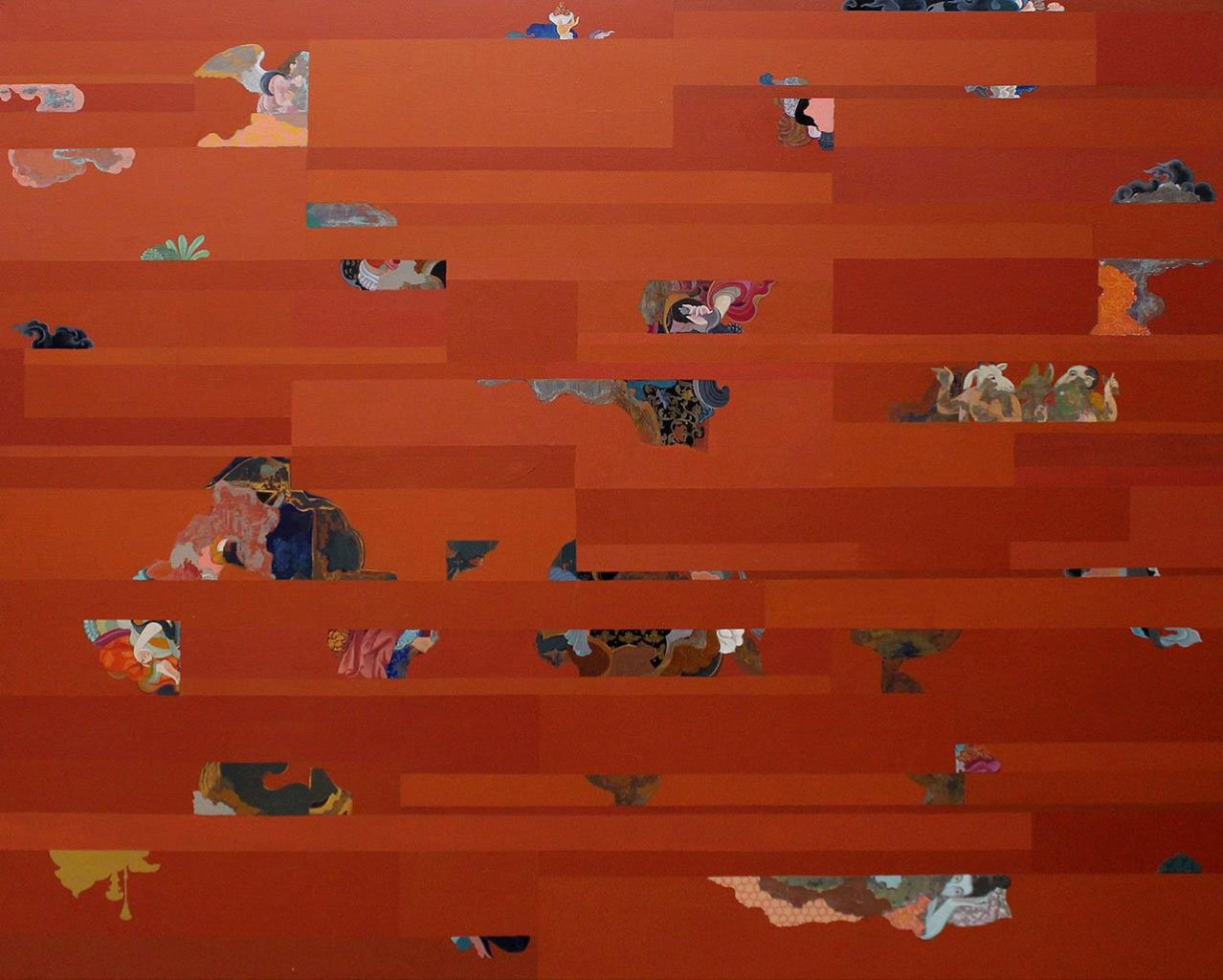
If there’s a strand in modern Indian art right now that resists easy description, it’s the one running through artists like Manjunath Kamatha: work that is neither nostalgic nor obviously contemporary, that draws on iconographic traditions from Karnataka temples and Yakshagana theatre and Persian miniatures and Victorian upholstery and makes something genuinely strange from the combination. Kamath builds his canvases in twenty-five layers, deliberately simulating the kind of erosion that happens to sculptures over centuries. The result looks excavated, not made. That’s the point, he’s interested in how cultures leave marks on each other, how styles travel across geography and time, how missing pieces generate meaning rather than eliminating it.
What Kamath represents in the broader landscape of modern Indian art is a counter-argument to the idea that contemporary means non-referential. His work is saturated with reference, mythological, devotional, colonial, decorative but the way those references collide produces something that couldn’t exist in any earlier moment. A 12-foot terracotta figure acquired by LACMA in 2024 is proof enough that this isn’t a local conversation anymore.
Indian sculptural traditions and something to comic books
N.S. Harsha’s work has been doing something quietly radical for thirty years: insisting that the local and the global are not opposites, and that a painter working in Mysuru can be as engaged with the political order of the world as anyone in a capital city. His canvases are populated with recurring figures such as farmers, clowns, suited businessmen, school children all arranged in grids that owe something to Indian sculptural traditions and something to comic books and something to textbook diagrams. He’s described the process as a kind of chanting with forms, which is the right word for it: the repetition builds accumulative weight rather than redundancy.
Diaspora Conversations Getting More Complex
Indian artists working internationally or Indian-origin artists trained abroad who are now engaging more seriously with their heritage are producing work that resists easy categorisation. It’s no longer simply ‘East meets West.’ The conversations are more nuanced: about specific regional identities within India, about caste and language and politics that aren’t legible from the outside without context.
This is healthy. Art that can only be understood by insiders is hermetic. Art that requires some education from the viewer, that rewards attention, is something different.
The Shifting Centre of Gravity
Mumbai and Delhi remain important. But Bangalore, Kochi, Hyderabad, these cities are producing work and building audiences in ways that weren’t true fifteen years ago. India Art Fair draws attention to Delhi, but the actual production of modern Indian art is increasingly distributed.
For collectors, this matters. Regional scenes develop at different tempos, with different commercial pressures. An artist working seriously in Bangalore may have far more room to grow in every sense than someone already caught in the machinery of the primary market in Mumbai. At Tara Art, we’re based in Bangalore precisely because we think there’s something real here worth paying attention to.
What Hasn’t Changed
The work that holds up is still made by people who have something to say and the technical means to say it. Trend cycles come and go. The artists who build durable careers are the ones for whom the work itself is the point and not the market, not the Instagram reception, not the grant. That’s been true since long before 2026, and it’ll be true after whatever comes next.