
The most interesting art doesn’t always come from the biggest names. Some of the strongest returns and, more importantly, some of the most genuinely alive work being made in India’s contemporary art scene right now belongs to artists who haven’t yet made it onto the auction house radar. That gap between quality and recognition is exactly where a collector who pays attention can find something worth holding.
As interest in Contemporary Indian Art continues to grow among collectors, institutions, and investors, emerging artists are becoming an increasingly important part of the conversation. Their work often reflects new perspectives, experimental approaches, and evolving cultural narratives that shape the future of Indian art.
This isn’t a definitive list. It can’t be. The landscape shifts constantly, and anyone claiming otherwise is selling something. These are artists we’re watching closely at Tara Art in 2026, and worth your attention if you’re thinking seriously about emerging Indian artists to invest in.
N.S. Harsha
N.S. Harsha has been based in Mysuru his entire life, which is itself something worth noting in a contemporary art world that rewards mobility and institutional adjacency. Born in 1969, he studied at CAVA and then Baroda under Nilima Sheikh, and has been making work from Mysuru ever since. Absorbing everything from miniature painting and folk art to textbook illustrations and Bazaar Art, and feeding it into canvases that are crowded, funny, philosophically odd, and technically meticulous. His paintings don’t have a single narrative thread you follow. They have grids of figures, a mass wedding where one groom is drunk, a bride has married a dog, garlanded photographs stand in for absent parties and you work through them the way you’d work through a puzzle you’re not sure has a solution.
For collectors, Harsha represents a relatively unusual profile: an artist with major international exhibition history: Mori Art Museum, Victoria Miro, Biennale of Sydney, São Paulo Bienal, Artes Mundi prize and has remained committed to a provincial Indian city and a decidedly non-spectacular practice. His work doesn’t rely on scale or material excess. It relies on density of observation. That quality doesn’t date. And the fact that his auction record (set in 2010, at Saffronart) remains well below what the exhibition history would suggest tells you something about the gap between critical recognition and market valuation, which is exactly the gap where interesting collecting happens.
Manjunath Kamath
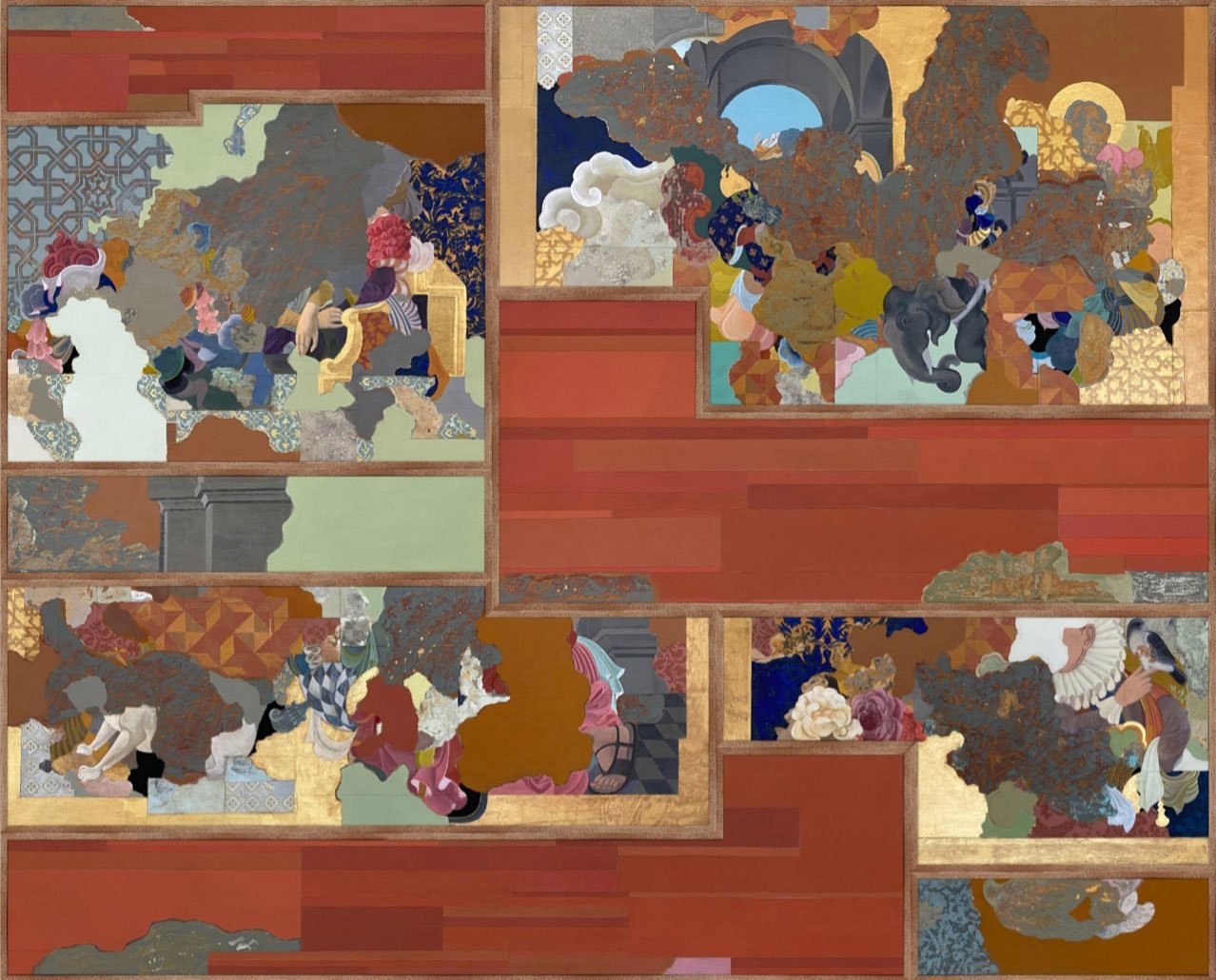
Manjunath Kamath is one of those artists who takes a lot of looking before you start to understand what’s actually happening. Born in Mangalore in 1972, trained first at CAVA Mysore and then in Cardiff, he works across painting, drawing, terracotta sculpture and digital collage and the connections between those mediums aren’t arbitrary. His practice is built around fragmentation and time: surfaces layered to resemble excavated ruins,
figures borrowed from Yakshagana plays and Chola bronzes and Persian miniatures and Ravi Varma’s canvases, assembled into compositions that feel simultaneously ancient and assembled yesterday. The missing pieces are deliberate. He’s said as much that the gaps in ancient sculpture are where nature and chance become co-authors. His canvases work the same way.
What makes Kamath worth watching from a collector’s perspective is that his work has been quietly building serious institutional backing for years. A 12-foot terracotta
sculpture entered LACMA’s collection in 2024. His works sit in the Detroit Museum, the Art Institute of Chicago and KNMA. Solo shows at SCAD Museum of Art and Abu Dhabi Art. That kind of institutional presence doesn’t happen by accident, and it rarely reverses. Kamath is not an artist who emerged suddenly, he’s one who rewards sustained attention, and whose work will likely hold up precisely because it isn’t chasing a moment.
The Case for Artists with Institutional Training (G.R. Iranna)
This isn’t a rule, but it’s a pattern worth noting: artists who have come through strong institutional programmes — Faculty of Fine Arts Baroda, NID, Santiniketan, CEPT tend to have a more developed sense of their own practice. They’ve had to articulate what they’re doing and why. That discipline shows in the work.
G.R. Iranna, from Karnataka, is a good example of someone whose institutional training fed into something deeply personal. He works with materiality in a way that feels considered, impermanence, memory, the spiritual textures of lived experience. His work isn’t loud. It accumulates.
Artists from Kerala: A Scene Worth Following
Kerala has produced a disproportionate number of strong contemporary artists, partly because of NID and design culture, partly because of something harder to explain.
Sachin George Sebastian, born in Kanhangad, is a case in point. His background in communication design informs how he builds an image. There’s a visual intelligence to his work that doesn’t feel accidental.
Collectors looking at top Indian contemporary artists would do well to pay attention to Kerala-based artists more broadly. The work coming from that part of the country tends to be rigorous without being cold, a combination that holds up over time.
Suchender P.
Suchender P. was born in Karimnagar, Andhra Pradesh in 1976 and trained at CAVA Mysore, the same institution that produced N.S. Harsha and Manjunath Kamath, which tells you something about both the school and the seriousness of his formation. He works primarily in watercolour, a medium that rewards control and punishes hesitation. His subject is the relationship between humans and animals in a landscape that has been increasingly reorganised around human use: not wildlife as spectacle, but wildlife pressed into uncomfortable proximity with urban life. His starting point was straightforward, news reports of wild animals entering cities and then he turned it inside out. It’s not the animals encroaching. It’s the humans who moved first.
Suchender has shown at Gallery SKE in Bangalore and Anant Art Gallery in Delhi. His work is quieter than the Indian art market typically rewards, which is part of why it’s worth paying attention to now. Watercolour on paper has a long history of being undervalued relative to oil on canvas and then, periodically, suddenly not being undervalued at all. For a collector building a considered collection rather than a high-profile one, works like Suchender’s offer something most of the market has moved past: real skill, a clear argument, and room to grow.
What to Look for Beyond the Name
If you’re genuinely trying to invest in emerging Indian artists rather than just buy art you like (which is also valid, and maybe wiser), a few things matter more than press coverage. Exhibition history: where they’ve shown, who curated it, whether international institutions have taken notice. Work across series: an artist who has made one strong body of work and nothing else is harder to back than one who keeps evolving. And the question of whether the work holds its own outside the studio.
We’ve been advising collectors since 2007, first as Tangerine Art Space, now as Tara Art. One thing that hasn’t changed: the artists who appreciate most, in every sense of the word, are the ones who were already making serious work before anyone was looking. Look for that.
We’ve also covered the broader shifts in modern Indian art trends if you want context on where the market is heading.